The re-sync problem
A protocol change is never just a protocol change. Move one visit in the schedule and the consent form’s procedures section, the coordinator worksheets, the screening logic, and the registry version all owe an update. When those live in separate files, each is only as current as the last person who remembered to fix it.
Drift between a protocol and its derived documents is not cosmetic. It produces protocol deviations, consent versions that describe procedures the protocol no longer contains, IRB re-submissions, cost, and delay.
How generation works
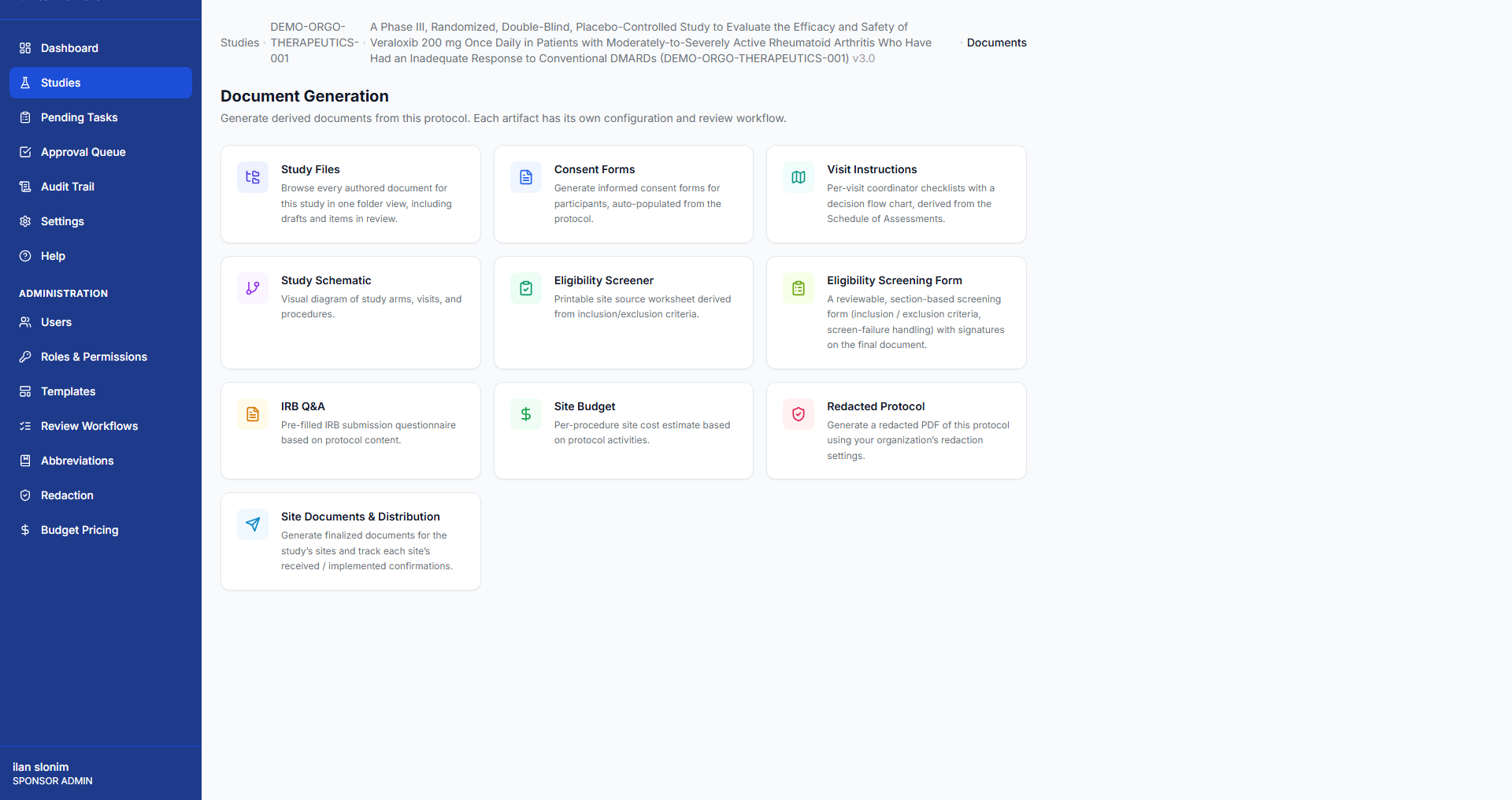
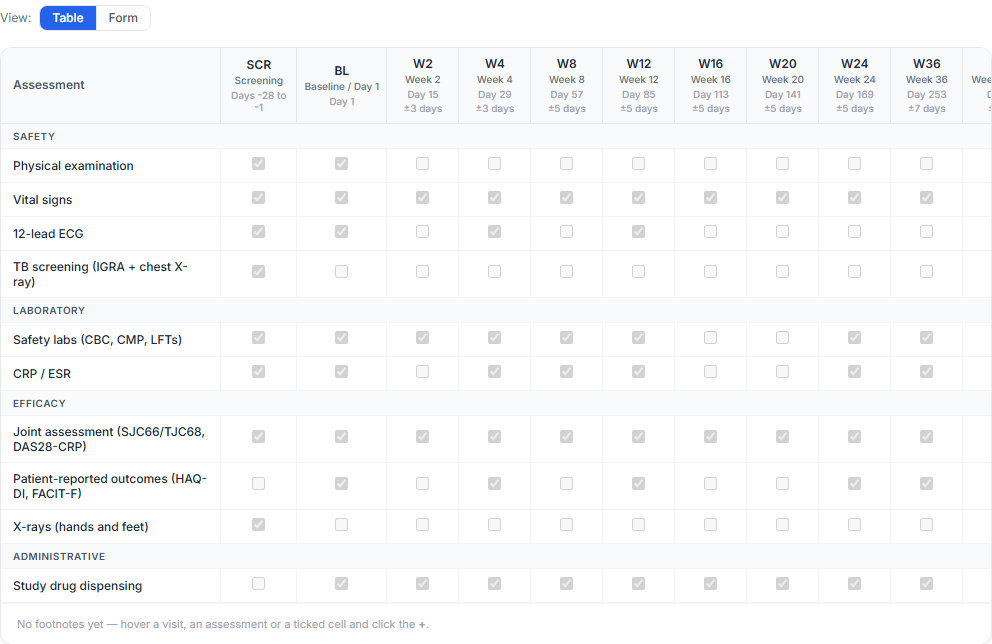
Trelice documents are generated from the protocol’s structured data, not from copied text. The schedule of assessments, the eligibility criteria, the study design, and the treatments are fields the platform can read, so a visit worksheet or an eligibility screener is computed from the source rather than retyped beside it. Downstream document generation is repeatable by construction: when the protocol moves, its documents can follow.
Informed consent form (ICF) generation
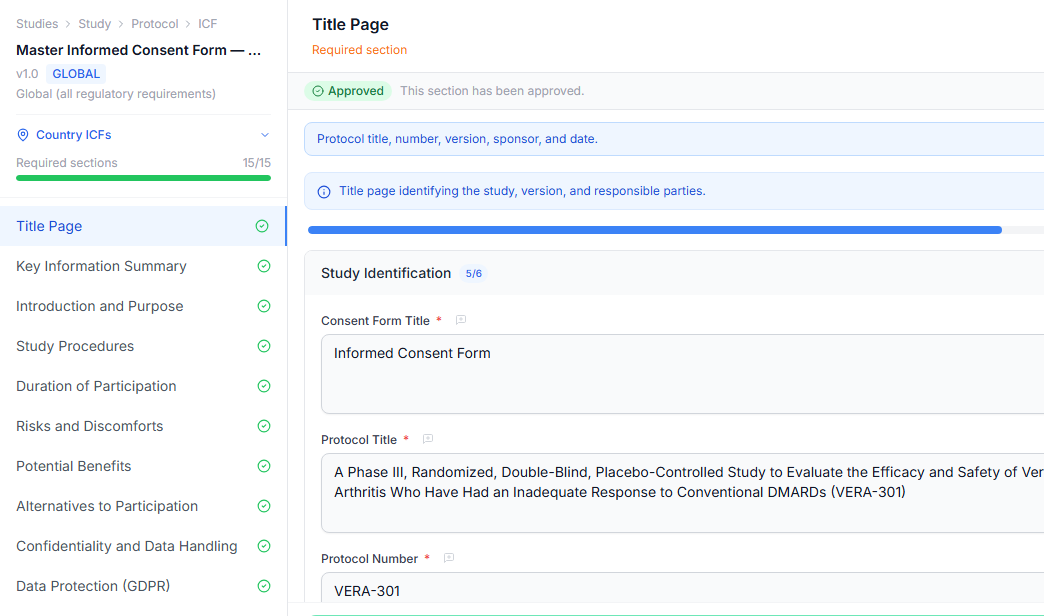
Trelice drafts a master informed consent form from the protocol, one per region (United States, European Union, or global), with 16 sections covering what regulators expect, from the key information summary through the signature block (see the master consent form). Drafted sections are plain language, measured against a reading-level target on the Flesch-Kincaid scale; a section above the target cannot be submitted for review until it is simplified. Consent sections move through the same review workflow as protocol sections, structured for IRB submission.
The informed consent form generator also covers languages and countries. Translations are drafted per section and reviewed by qualified language specialists before they count (see translations and country versions). Country consent forms adapt the master for one country and language, with local regulatory notes surfaced, including back-translation requirements, and an out-of-date warning when the master changes after generation. That is ICF translation and country versions handled as generation, not as parallel files.
For teams whose protocol lives outside Trelice, the ICF Generator drafts a consent form from an uploaded protocol PDF: upload, extract, generate, then edit, review, and export in the same editor. CROs and agencies use it to produce consent forms without re-authoring a sponsor’s protocol.
Site visit worksheets and the subject booklet
Visit instructions turn the schedule of assessments into a workbook a study coordinator can hold: one worksheet per visit, every procedure in order with tick-boxes, result lines, and signature lines, plus standard adverse-event and concomitant-medication blocks on every visit (see visit instructions and the subject booklet). Studies with branching paths get a router page and yes/no question pages, so each printed worksheet stays unconditional.
The subject booklet resolves those branches for one participant: answer the routing questions once and print a booklet with exactly one worksheet per visit. These are working source documents, generated per site and per participant where that matters.
Eligibility screener and screening forms
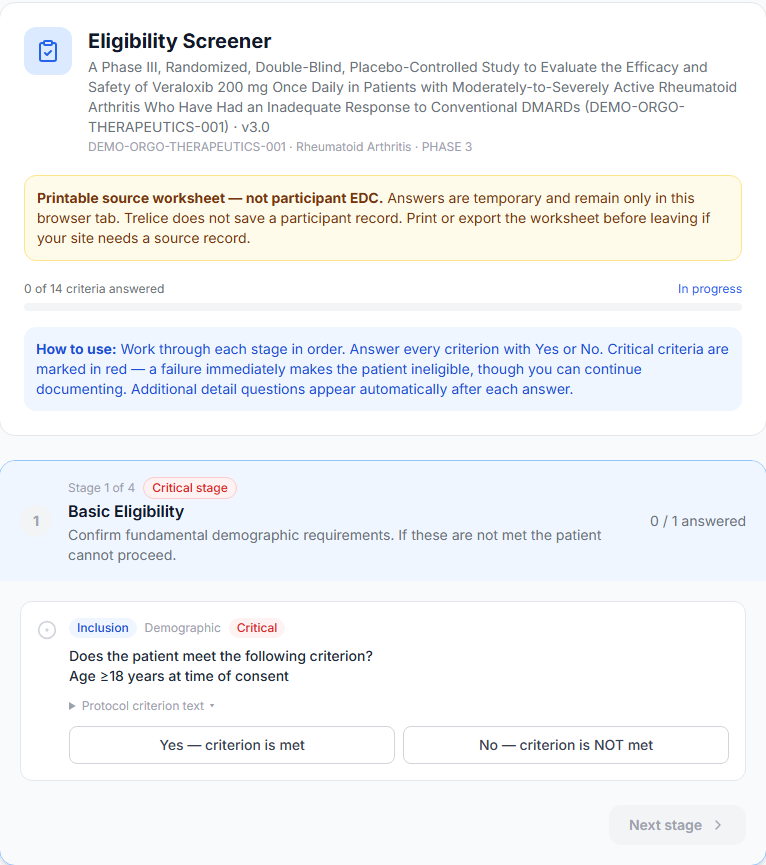
Inclusion and exclusion criteria flow from the protocol into an interactive eligibility screener: staged yes/no questions about one candidate, critical criteria that end screening on their own, and an eligible or not eligible result that quotes each failed criterion’s protocol text (see the eligibility screener). Change the criteria in the protocol and the screener changes with them; nothing is written twice. The answered screener prints for the candidate’s file, and Trelice stores no participant answers.
IRB and ethics committee questionnaire
Ethics committees ask a long, predictable list of questions, and the protocol already answers most of them. The IRB questionnaire collects those answers into one document, grouped by topic with the governing regulation named, and each answer cites the protocol sections it came from (see the IRB questionnaire). Questions the protocol cannot answer yet are marked as such, with the section to complete named. It regenerates fresh each time it is opened, so the answers always match the protocol as it stands.
Study schematics
The study schematic draws the design figure reviewers expect on page one: arms, phases, and visits, generated from the study design, the schedule of assessments, and the treatments (see the study schematic). Because it is generated, it cannot drift out of date the way a hand-drawn figure in a Word file can.
Summary of changes
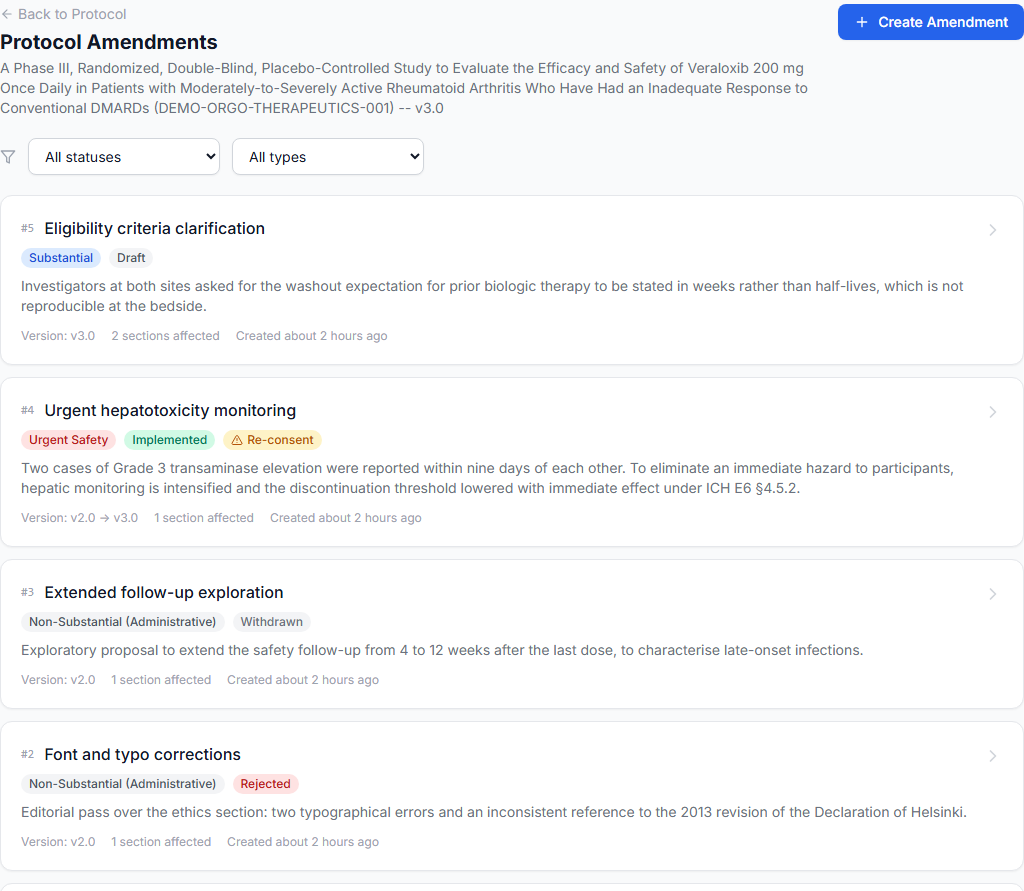
Each protocol amendment produces a summary of changes: every changed field grouped by section, old and new values side by side, removals struck out and additions highlighted, schedule changes rendered as a table diff, and the written reason recorded for every change (see creating and editing an amendment). The summary downloads as PDF or Word, and the amendment history table follows ICH E3 amendment tracking with CSV export (see amendment history and versions). Cover letters stop being archaeology.
Site budget
The site budget prices every procedure at every visit from the schedule of assessments and your organization’s pricing library: cost per patient, total study cost, per-country comparisons, and per-visit breakdowns, recalculated live from the current schedule (see the site budget).
Redacted protocols
Public disclosure and clinical trial transparency require redacted protocol versions. In Trelice, redaction is a library, not a markup pass: administrators decide once which fields are blacked out, with recommended defaults following EMA Policy 0070 and explicit warnings when a chosen field is normally required to be disclosed (see redaction settings). Every redacted PDF applies the same rules automatically, one click from the protocol (see downloading PDF and Word documents).
The amendment cascade
What makes generated documents worth having is the day the protocol changes. A protocol amendment in Trelice is made once, in the protocol, with tracked changes and written reasons (see creating and editing an amendment). From there, the protocol amendment cascade is the platform’s job.
Documents computed from structured data (the eligibility screener, the study schematic, the IRB questionnaire, the site budget) rebuild from the current protocol every time they are opened or exported. Visit instructions detect that the schedule of assessments changed and show a banner offering regeneration, preserving any hand-edited sections. Country consent forms warn that the master changed after they were generated, so outdated versions cannot circulate silently.
The people side is tracked too. Amendment site notifications move from pending to notified to acknowledged, per site, and country submissions are recorded by type, so a distributed study knows exactly who has seen the change (see the amendment workspace).
The manual alternative is an amendment implemented across separate files by separate people on separate timelines. One source of truth, and documents that follow it, is the difference between an amendment and an incident.
Requesting another document type
The generation pipeline is built to take on new document types. If a trial needs a document Trelice does not generate yet, request it and it joins the roadmap conversation.