Managing the protocol development process
Most authoring tools concentrate on the document and leave the process around it to email. The daily work of protocol development is coordination: sections assigned, drafts reviewed in the right order, approvals collected, deadlines held. Trelice manages that process directly.
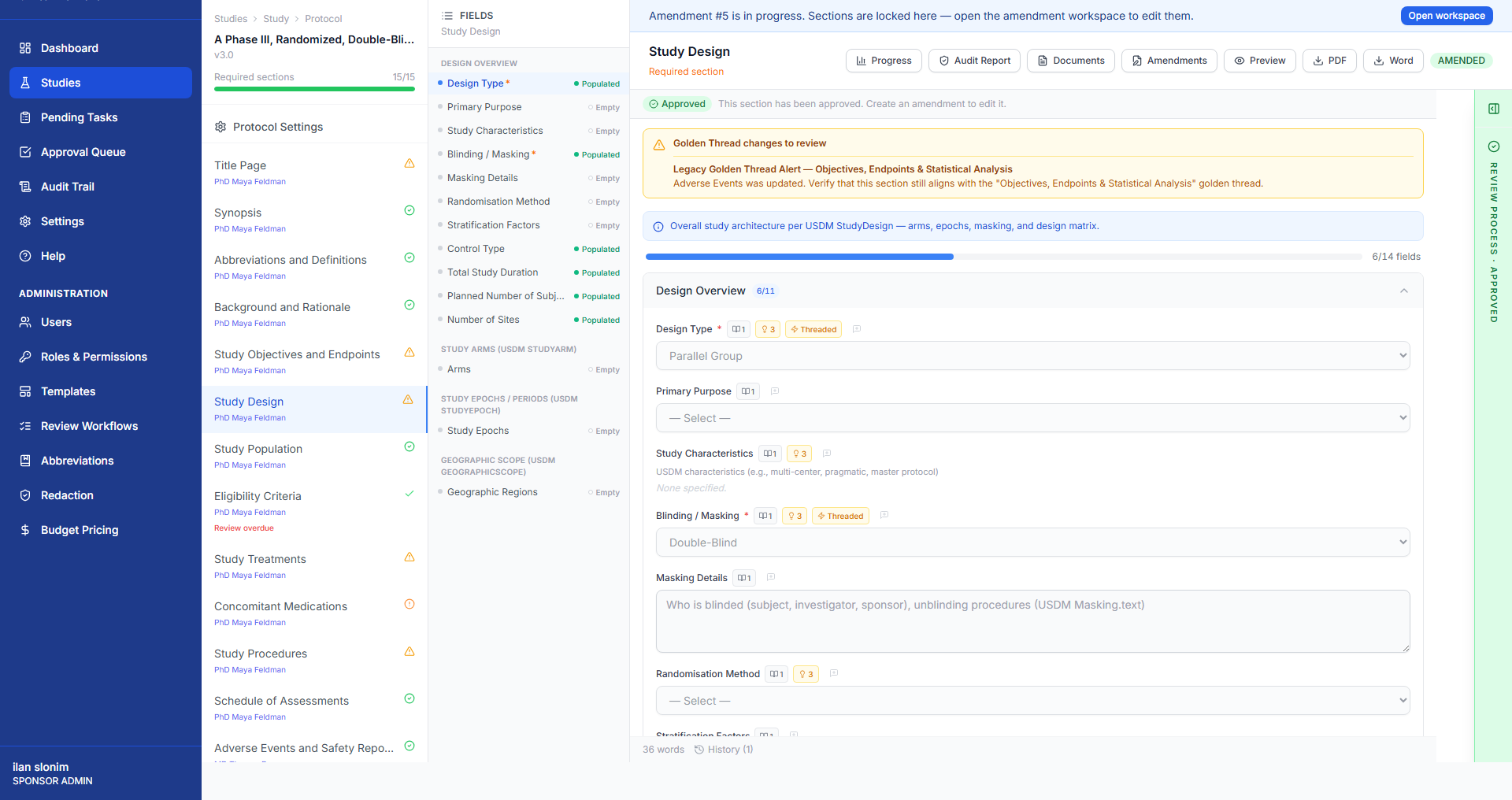
Every protocol section carries an assigned writer, an authoring due date, and a review due date, set in the editor and visible in the section list; overdue work turns red (see sending a section for review). Review follows a workflow your administrators define: levels of reviewers, reviewed in order, with the next level notified only when the previous one approves (see setting up review workflows). At submission, Trelice checks that every required role in every level is staffed.
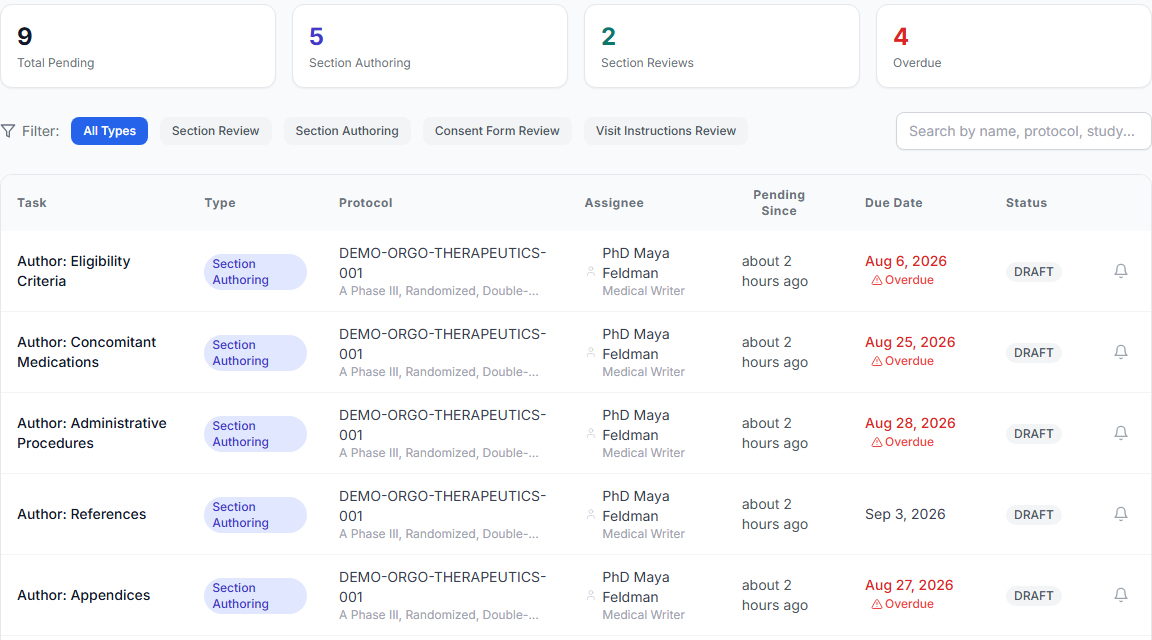
Reviewers decide from a personal approval queue that collects the sections waiting on them. Outstanding work across every protocol sits on one pending-tasks page, with due dates, overdue flags, and a reminder button that notifies colleagues without anyone writing a chasing email. Automatic reminders go out as due dates approach, and overdue notices reach administrators too (see notifications and reminders).
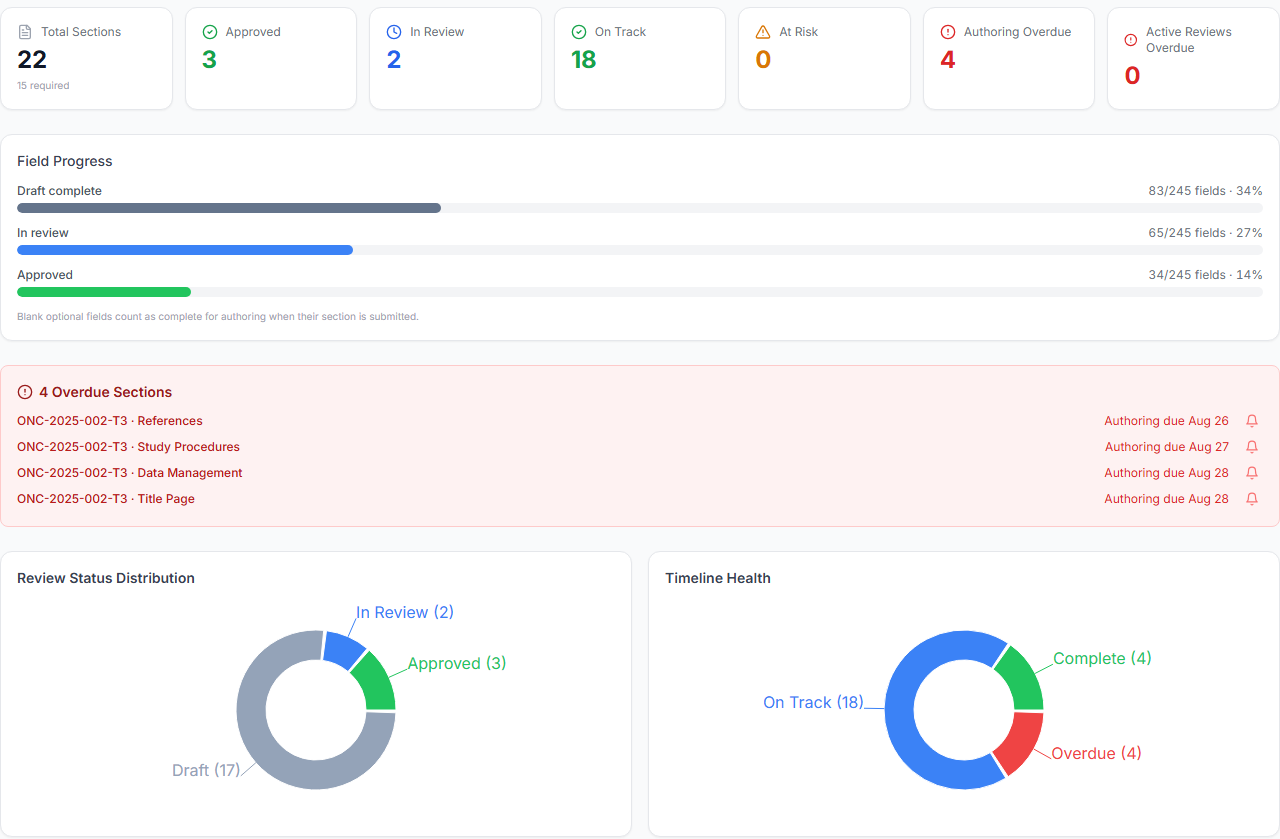
Progress is visible instead of asked about. The protocol status dashboard summarizes active studies and protocols pending review across the organization, and each protocol has a progress page showing section-by-section status, at-risk and overdue work, and sections nobody has been assigned yet (see progress and audit reports).
Approvals are recorded as electronic signatures, every action lands in a permanent, append-only audit trail, and access is governed by role-based permissions across 14 roles, from platform administrator to read-only viewer. More on team workflows on the collaboration page.
The problem with Word templates
Most protocols are still written in Word templates inherited from the previous study. Content is copied forward from prior protocols, the structure lives in the writer’s memory, and interdependent sections drift. The primary endpoint appears in the synopsis, the objectives, and the statistical considerations. Eligibility criteria are referenced in screening, enrollment, and analysis. The schedule of activities feeds half the document. Keeping all of that aligned by hand, across drafts and amendment cycles, is exactly the kind of work people do imperfectly.
The cost of drift is concrete: review cycles spent hunting inconsistencies, protocol amendments filed to fix internal contradictions, and questions from regulators and ethics committees that a consistent document would not have drawn.
Structured protocol authoring
In Trelice, a protocol section is a form, not a blank page: labeled fields, dropdowns, and lists arranged in a structure aligned with ICH M11, the structured harmonised protocol standard. The framework dictates what belongs where, so the structure stops living in any one writer’s memory (see filling in structured sections).
Fields carry their regulatory context. Badges beside a field open the regulations and guidance that require or govern it, with hard requirements marked for the countries the trial runs in. Writers see why a field exists while they fill it in.
Organizations standardize the starting point with protocol templates: reusable outlines with a section order, per-section writer roles, required reviewer roles, and instructions for the author.
Protocol import
Not every protocol starts in Trelice. When one arrives as a Word file or a PDF, Trelice reads it: upload the document and the text is extracted and parsed into the structured sections, with a report of what landed where (see working with studies). Source content that matches no standard section is kept under the appendices, so nothing from the original is lost, and a protocol written in another language is translated to English with the original file kept attached for verification.
Teams that only need consent forms skip protocol import entirely. The ICF Generator drafts an ICF straight from an uploaded protocol PDF, which is how CROs and agencies serve sponsors whose protocol lives elsewhere.
Native to ICH M11, not retrofitted
There are two ways to meet a structured protocol standard. One applies M11-style headings to a Word template and keeps authoring free text underneath them. The other builds the authoring structure on the standard itself, so sections, fields, and terminology follow it natively. Trelice takes the second path.
The difference shows up at authoring time, not export time. Structured fields can be validated, linked across sections, and read by downstream document generation. Text under headings cannot.
Cross-section consistency checking
Trelice’s consistency system is called golden threads (cross-section consistency checking). Five threads cover the facts a protocol states more than once: objectives, endpoints, and statistical analysis; inclusion and exclusion criteria; the schedule of assessments; dosing and interventions; and sample size assumptions.
Where a value is a true copy, editing it in one section updates every linked section. Where the relationship is looser, prose that discusses an endpoint rather than repeating it, Trelice flags every related section for a human check when the source changes. Reviewers must acknowledge an open consistency alert before they can approve, and that acknowledgment is recorded by name and date (see golden threads).
Inconsistency stops surviving unnoticed.
Amendments
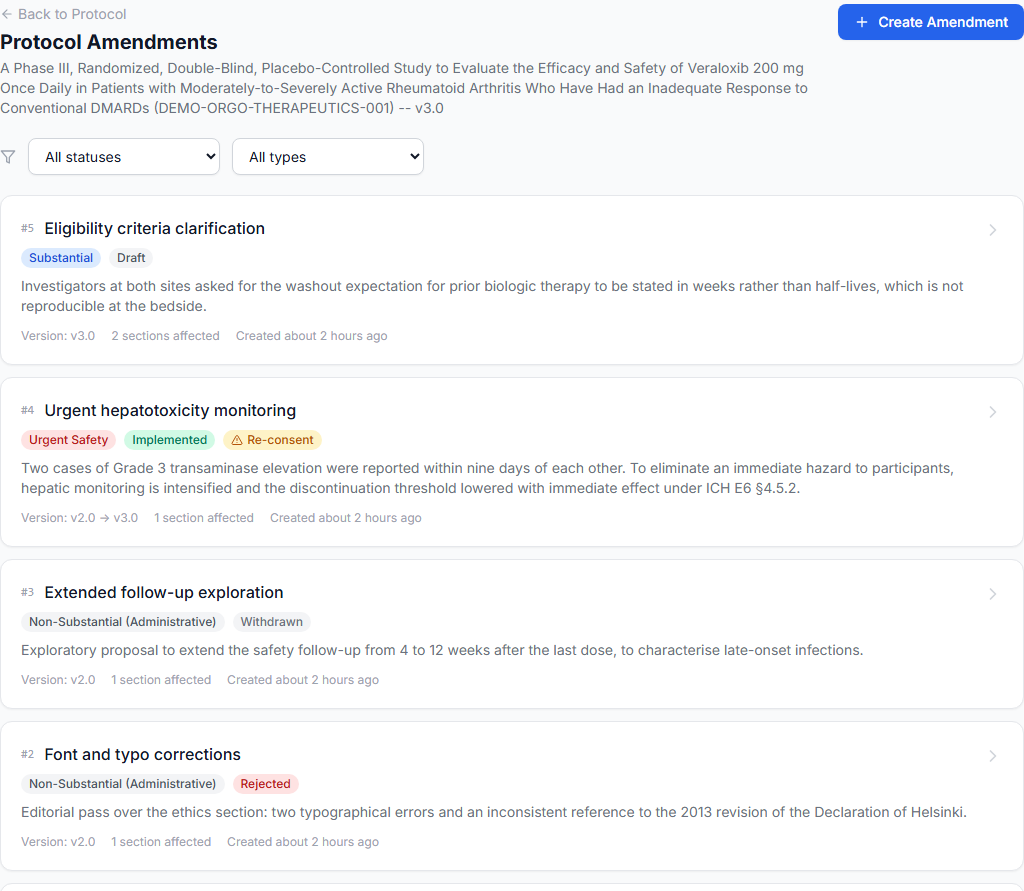
Approved protocols are locked. Changes go through a formal protocol amendment: each edited field records its old value, its new value, and a written reason; the amendment carries its own review chain, IRB and regulatory decision tracking, and per-site notification status; and every implemented amendment freezes a numbered protocol version that stays downloadable forever (see creating and editing an amendment).
A summary of changes is generated for each amendment as PDF or Word, and the documents generated from the protocol flag for regeneration rather than falling quietly behind. That cascade is covered in depth on the downstream documents page.
Regulatory context
ICH M11 was adopted in November 2025 and takes effect in June 2026. Protocols authored in an M11-aligned structure are prepared for that transition without a re-authoring project.
Trelice is architected for 21 CFR Part 11, with audit trails built in from the ground up; validation is in progress.