Faster protocols,
fewer
amendments.
A purpose-built authoring platform for clinical protocols, where every field carries its regulatory rationale, every update ripples through the entire protocol, and downstream documents are effortlessly generated.
Limited time 9 of 25 trial spots left.
A short walkthrough of authoring a protocol and generating its downstream documents.
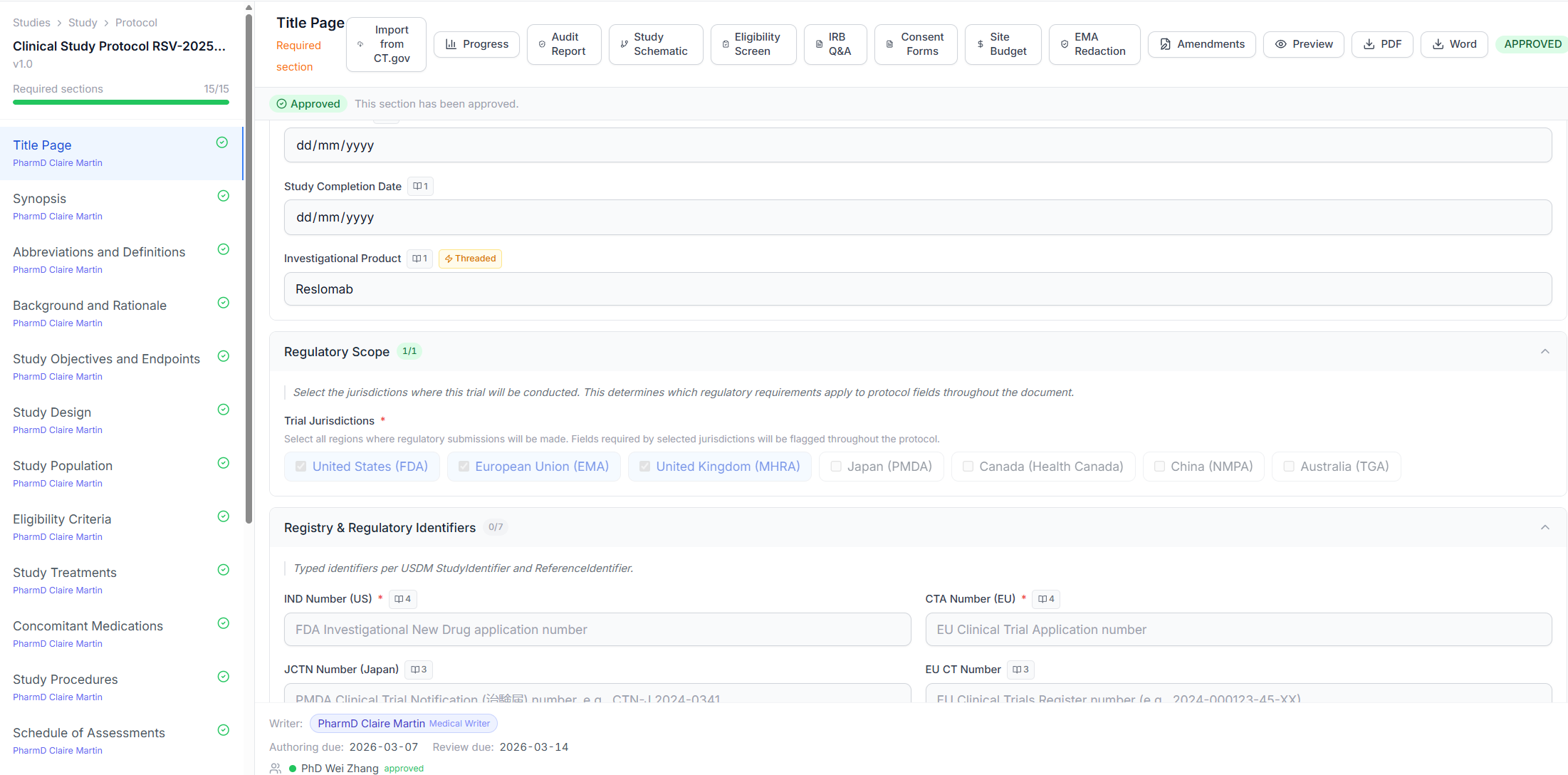
What Trelice is
Trelice is a clinical trial protocol authoring platform built natively on the ICH M11 structured protocol standard. Clinical operations teams and medical writers at pharma sponsors of any size use it to author study protocols in a structured, regulatory-led format instead of Word templates.
From the approved protocol, Trelice generates the downstream documents that depend on it: informed consent forms (ICFs), site visit worksheets, IRB/EC question-and-answer documents, and redacted protocols for public registry disclosure. It also generates a version of each document for each site, the way source documents should be. When the protocol is amended, every generated document flags for regeneration. That prevents the inconsistency that comes from re-syncing files by hand.
Trelice also manages the protocol development process itself. Sections are assigned to writers and reviewers with due dates, approvals move through a queue, progress is visible on a dashboard, and electronic signatures and a permanent audit trail record every step.
Trelice is architected for 21 CFR Part 11, with audit trails built in from the ground up. It was shaped in close collaboration with clinical trial practitioners.
ICFs, redactions, screening forms and more, instantly ready and always up to date.
The protocol is only the start. Every document a trial derives from it is generated straight from your approved protocol, and the moment the protocol changes, each one flags for regeneration. No more rebuilding the same content by hand across five files and hoping they still agree.
Informed consent forms
Master, country, site, and population-specific ICFs generated directly from the protocol, in plain language and ready for IRB submission.
Redacted protocols
Public-disclosure and transparency redactions applied automatically and consistently, ready for submission without a manual markup pass.
Screening & eligibility forms
Inclusion and exclusion criteria flow from the protocol into screening forms that stay in lockstep every time the criteria move.
Another document type
If your trial needs a document Trelice does not generate yet, reach us and we will add it to the pipeline.
Request a document type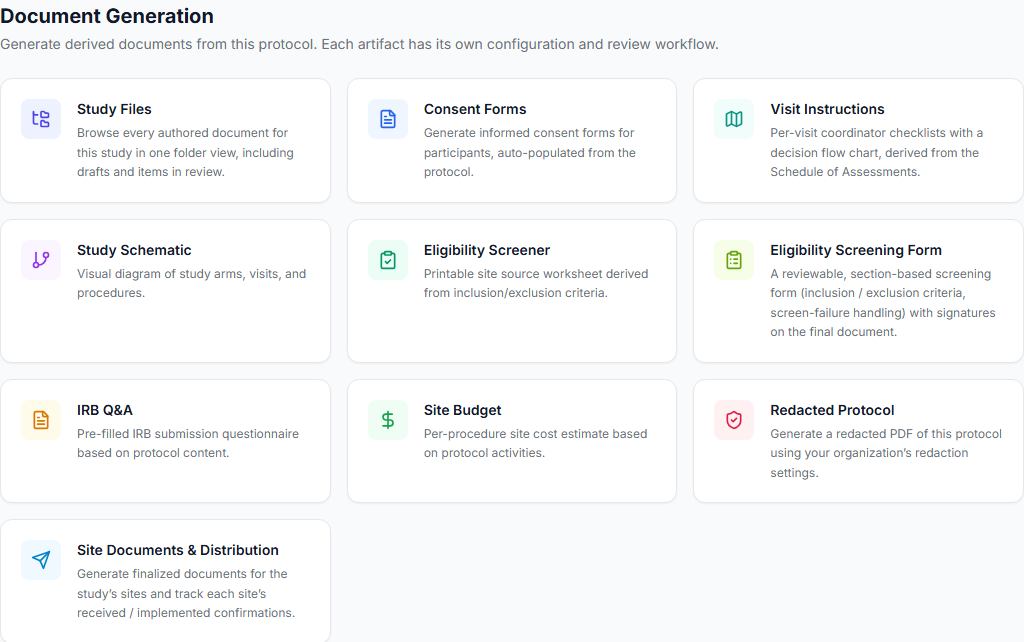
The protocol authoring platform clinical trials deserve.
Clinical trials teams stitch together Word templates, chase down regulatory citations, and re-sync every downstream document by hand. Every edit is an opportunity to drift out of compliance, incur additional cost, and delay study timelines.
Keeping up with regulations, so you don’t have to.
Tell Trelice where your trial will run, and the protocol reshapes itself to every country or region you select, adding the fields each jurisdiction requires and citing the exact regulation behind every one, so you can feel confident your protocol won’t be rejected over a compliance gap.
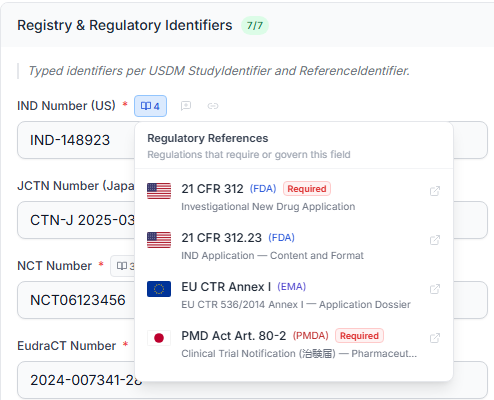
Built for regulators, not retrofitted for them.
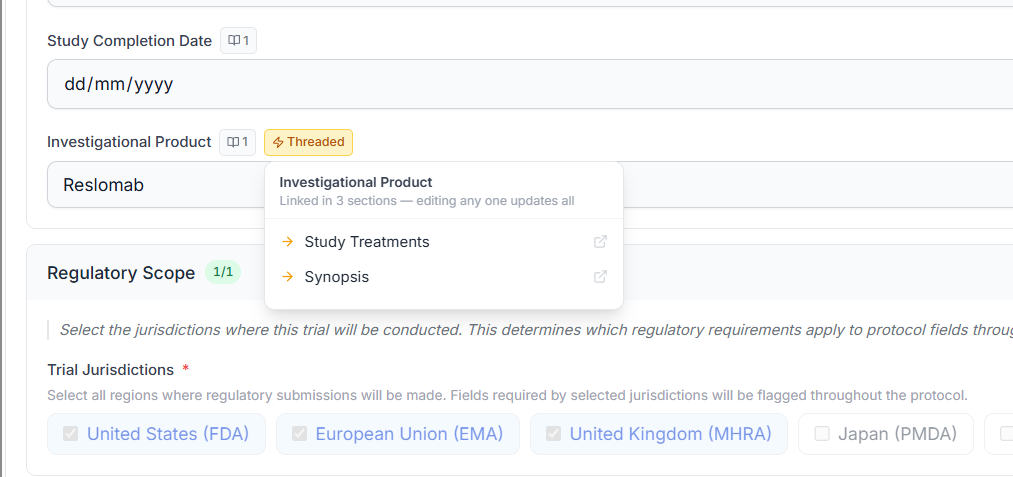
Change an endpoint. Watch every relevant section update itself.
Trelice's protocol modules are intelligently linked together. When you revise a field that appears in multiple protocol sections (a primary endpoint, say), the platform propagates the change to every other relevant section: synopsis, eligibility, objectives, statistical analysis.
What used to take a medical writer three weeks takes three minutes. The platform prevents the inconsistency that hand-synced sections accumulate.
- Repeating data tagged by the system
- Bidirectional links between all related fields
- Change impact preview before you commit
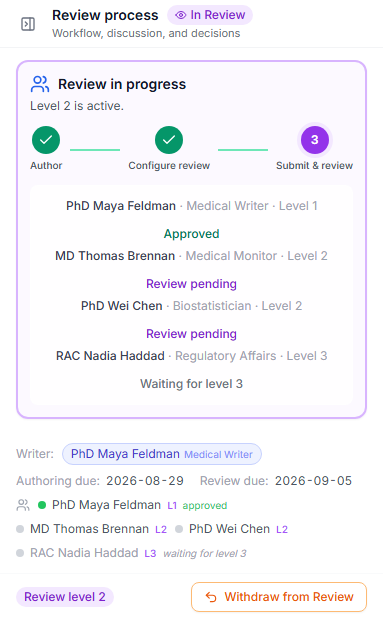
Assign reviewers, and watch the approvals roll in.
No more frantically chasing down team members via email to make sure they reviewed the protocol. Simply assign reviewers in Trelice and watch the approvals roll in. Export the review and approval audit trail with the click of a button to demonstrate regulatory compliance.
Nothing reaches a regulator without the right eyes on it. Every decision is captured with an electronic signature and a full audit trail, architected for 21 CFR Part 11.
- Assign named reviewers and approvers per section
- One-click export of the full review & approval audit trail
- Electronic signatures on every sign-off, architected for 21 CFR Part 11
Submission-ready formatting, checked automatically.
Once you've finished writing, Trelice automatically QCs your protocol for consistency, adds bookmarks and in-document linking, and puts all formatting in submission shape.
What used to take medical writers weeks is now done automatically in minutes.
- Automated consistency and terminology checks
- Bookmarks and in-document cross-links added for you
- Submission-ready formatting applied in minutes, not weeks
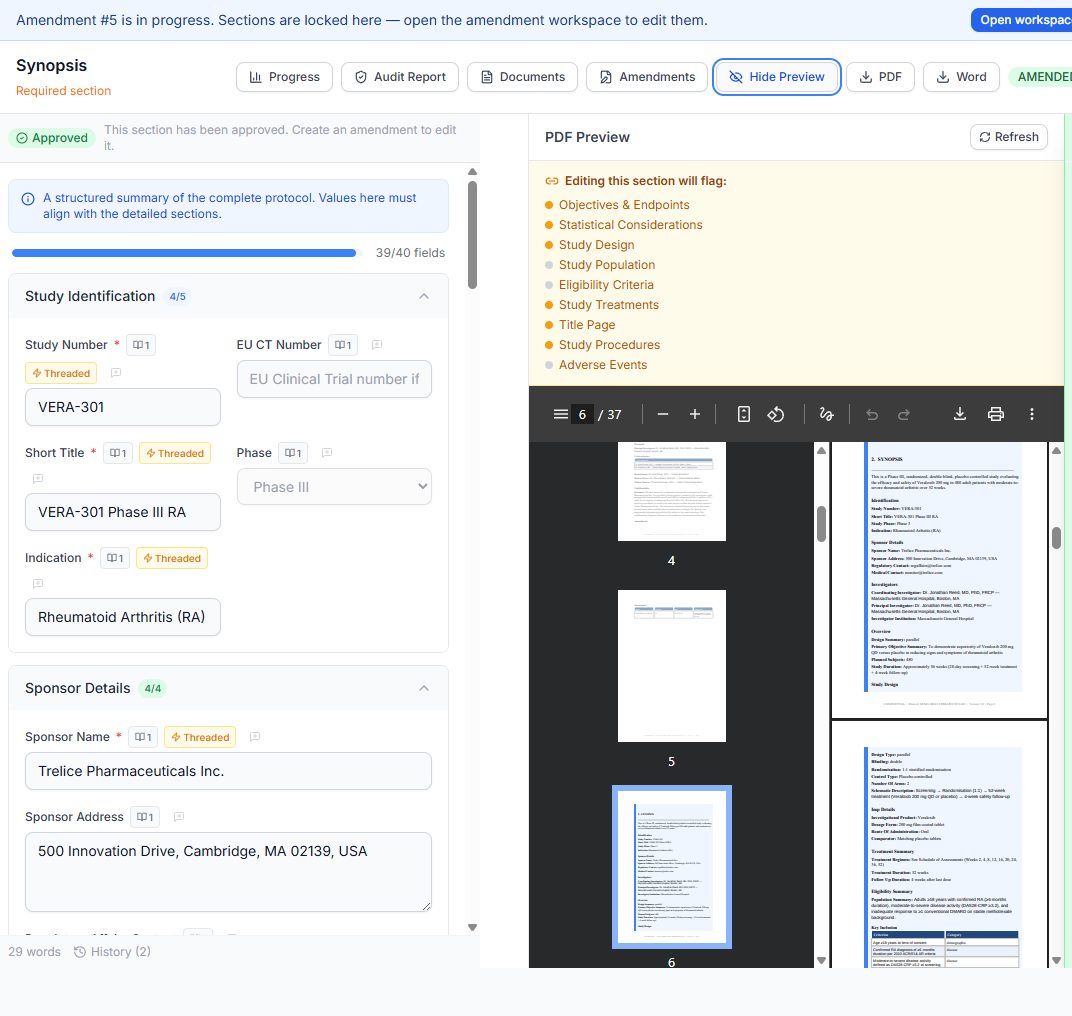
See your protocol in Word or PDF, live as you type.
Prefer to see your protocol in Word or PDF as you go? The live document preview updates as you type. Export at any time to get the fully formatted, submission-ready Word or PDF document.
- Faithful Word and PDF rendering with your organization's template
- Track changes, comments, and redlines preserved on export
- One-click submission-ready PDF with bookmarked sections
You write the protocol, we generate the ICF.
The informed consent form has always been the hardest downstream document: plain language, legally binding, jurisdictionally varied, rewritten every time the protocol shifts. Trelice automates it.
Authoring
The structured protocol authoring system. Regulatory rationale per field, intelligent linking, native approval flow, live document preview.
Explore AuthoringICF
Create master, country, site, and population-specific consent forms with the click of a button directly from the approved protocol. IRB-ready and auto-regenerating, with plain language held to a patient reading level.
Explore ICFOne protocol, working for every actor in the trial.
A trial is run by sponsors, CROs, and sites, and each of them spends weeks producing documents the others depend on. Trelice generates each actor’s documents from the same approved protocol, so every team starts sooner and nothing drifts out of sync between them.
Sponsors
Write the protocol in weeks, not months.
Author the protocol in a structured, ICH M11-native editor instead of a Word template. Every field carries its regulatory rationale, linked sections stay consistent as the design evolves, and reviews, signatures, and the audit trail live in one place, so lean teams move from synopsis to a submission-ready protocol without hiring an army.
CROs
Generate the deliverables, onboard sites faster.
Import the sponsor’s protocol, or pick up one authored in Trelice, and generate the documents your engagement depends on: master, country, and site-specific ICFs, plus eligibility screening forms driven directly by the inclusion and exclusion criteria. With each site’s document set generated instead of built by hand, site onboarding shrinks from weeks of document preparation to days.
Sites
Enroll sooner, audit-ready from day one.
Source documents arrive generated per site from the approved protocol: visit worksheets, subject booklets, and screening forms, ready before the first patient walks in. Coordinators start enrollment quickly instead of building paperwork first, and because every document traces back to the protocol version it came from, sites are fully audit-ready for source document review from the get-go.
Frequently asked questions
What is Trelice?
Trelice is a clinical trial protocol authoring platform. Protocols are written in a structured format aligned with ICH M11, and downstream trial documents are generated directly from the approved protocol.
Is Trelice ICH M11 native?
Yes. Trelice is built natively on the ICH M11 structured protocol standard rather than retrofitting M11 headings onto Word templates. The authoring structure itself follows the standard.
Does Trelice generate informed consent forms (ICFs) from the protocol?
Yes. Master, country-, site-, and population-specific ICFs are generated directly from the approved protocol in plain language, and they flag for regeneration whenever the protocol changes.
What other documents does Trelice generate?
Site visit worksheets and a printable subject booklet, an eligibility screener driven by the protocol’s inclusion and exclusion criteria, IRB/EC questionnaires, study schematics, a summary of changes for each amendment, and redacted protocol versions for public disclosure. Documents are generated per site where that matters, the way source documents should be. Additional document types can be added on request.
What happens when a protocol is amended?
The change is made once, in the protocol. Trelice keeps interdependent protocol sections consistent and flags every generated downstream document for regeneration, so amendments do not require manually reconciling separate files.
Is Trelice 21 CFR Part 11 compliant?
Trelice is architected to support 21 CFR Part 11 requirements, including audit trails, with validation in progress.
Who is Trelice for?
Clinical operations teams at pharma sponsors of any size are the primary users, alongside the medical writers who author protocols. CROs and agencies use Trelice’s document generation downstream.
Does Trelice manage writer and reviewer assignments?
Yes. Protocol sections are assigned to writers and reviewers with due dates (see sending a section for review). Reviewers approve or request changes from an approval queue, pending tasks are tracked per person (see pending tasks), and a dashboard shows where each protocol stands. Electronic signatures and a permanent audit trail record every step.
How do distributed teams collaborate in Trelice?
Everyone works on the same protocol in the browser. Comments are anchored to individual fields and resolved in place (see comments and working together), a banner shows who else is editing a section, and any field can be shared as a link that lands a colleague exactly there. Notifications arrive in the app and by email, with per-type preferences (see notifications and reminders).
Can Trelice manage several studies at once?
Yes. Studies are the top-level container, with statuses from concept through completed and a searchable studies list (see working with studies). A dashboard summarizes active studies, protocols in development, and pending reviews across the organization (see your dashboard), and one pending-tasks page tracks outstanding work across every protocol (see pending tasks).
Does Trelice handle abbreviations automatically?
Inserted abbreviations are expanded at their first mention in the exported document, and the Abbreviations and Definitions section builds itself from what the protocol actually uses. Definitions come from your organization’s shared library or the standard ICH/GCP set, and entries that are defined but unused are flagged (see writing and formatting text).
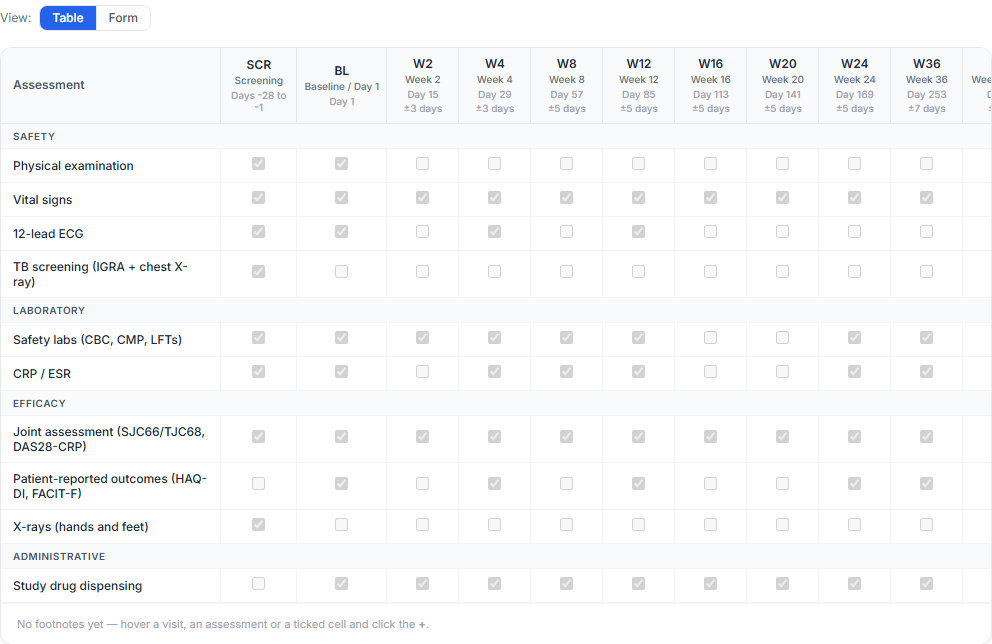
Does Trelice number Schedule of Assessments footnotes automatically?
Yes. Footnotes attach to a visit, an assessment, or a single cell. Trelice numbers and places them, renumbers them when visits or rows move, and lets one footnote be reused across the table (see filling in structured sections).
What is the summary of changes for an amendment?
A generated list of every field an amendment changed, old and new values side by side, with the written reason for each change. It downloads as PDF or Word, and the full amendment history exports to CSV (see amendment history and versions).
Can Trelice import an existing protocol?
Yes. Upload a PDF or Word protocol and Trelice extracts it into structured sections, reporting what was populated where; unmapped content is preserved under the appendices (see working with studies). The ICF Generator also drafts a consent form directly from an uploaded protocol PDF.
Will Trelice make it harder to collaborate with external reviewers?
No. Trelice does not charge per user, so you can invite principal investigators, medical experts, consultants, and other external contributors without purchasing additional seats.
Access can be limited to exactly what each person needs to review or edit. This allows external contributors to participate directly while protecting the rest of the study and your organization’s information.
Instead of reconciling multiple Word documents, conflicting tracked changes, and disconnected comments, your team can manage feedback in one controlled environment. When a document is ready for distribution, Trelice can export it to Word or PDF.
Is Trelice overkill for a small company or a single protocol?
No. Small teams often have the least capacity to absorb preventable mistakes, rework, and delays.
Trelice’s consistency checks, reusable content, automated document generation, and structured authoring capabilities do not require a lengthy implementation project. They support the team from the first protocol.
For a small sponsor, identifying an inconsistency before submission, or avoiding weeks of manual document reconciliation, can make the difference between keeping a study on schedule and experiencing a costly delay.
Why doesn’t Trelice use generative AI to write the protocol?
Trelice does not position generative AI as a substitute for scientific and medical judgment.
Clinical protocols contain consequential decisions that must be accurate, explainable, and approved by qualified people. Generative AI can produce convincing but incorrect information, omit important context, or introduce unsupported assumptions. In a regulated document, polished prose is not the same as reliable content.
Trelice focuses on helping authors create consistent, complete, traceable protocols while keeping people accountable for the scientific content. AI is used for bounded, reviewable tasks, such as converting an existing protocol into Trelice, not for inventing medical rationale or study design decisions.
Why doesn’t Trelice publish simple per-user pricing?
Because Trelice does not charge based on the number of users.
Per-seat pricing discourages organizations from including the reviewers and contributors needed to create a strong protocol. Trelice instead considers the scale and needs of your clinical development program, allowing you to invite internal and external collaborators without worrying about the cost of every additional seat.
This makes pricing predictable around the work being performed, rather than the number of people contributing to it.
Is migrating from Word and existing protocol processes difficult?
No. You do not need to rebuild every protocol manually or abandon your existing work.
Add your users, import your current protocols, and Trelice’s AI-assisted migration process converts them into structured protocols within the platform. Your team can review the imported content and continue working from there.
This provides a practical path from document-based authoring to structured protocol management without starting over, while preserving human review and control throughout the transition.
See a protocol draft itself in thirty minutes.
Bring a synopsis. We’ll walk through Authoring together on your actual study: regulatory rationale, intelligent linking, approval flow, live document preview, and the downstream ICF.
Try it now